
Chapter 2 · 2 of 6
Self-healing by snapshot
Freeze the whole machine at a moment the work is known to run correctly — a “snapshot”. Let the work prove it is alive with a steady signal. The instant that signal stops, return to the frozen moment within seconds.
A virtual machine — a complete software re-creation of an old computer, running inside a modern one — lets a vanished environment live on: a period operating system, its browser, its plugins, the artwork. And because the whole computer is now software, it can be frozen as a complete, verified state. A snapshot — a frozen copy of the machine’s entire memory and disk at one instant — preserves not a pile of installation files but the working configuration itself: the moment the work runs correctly.
The mechanism
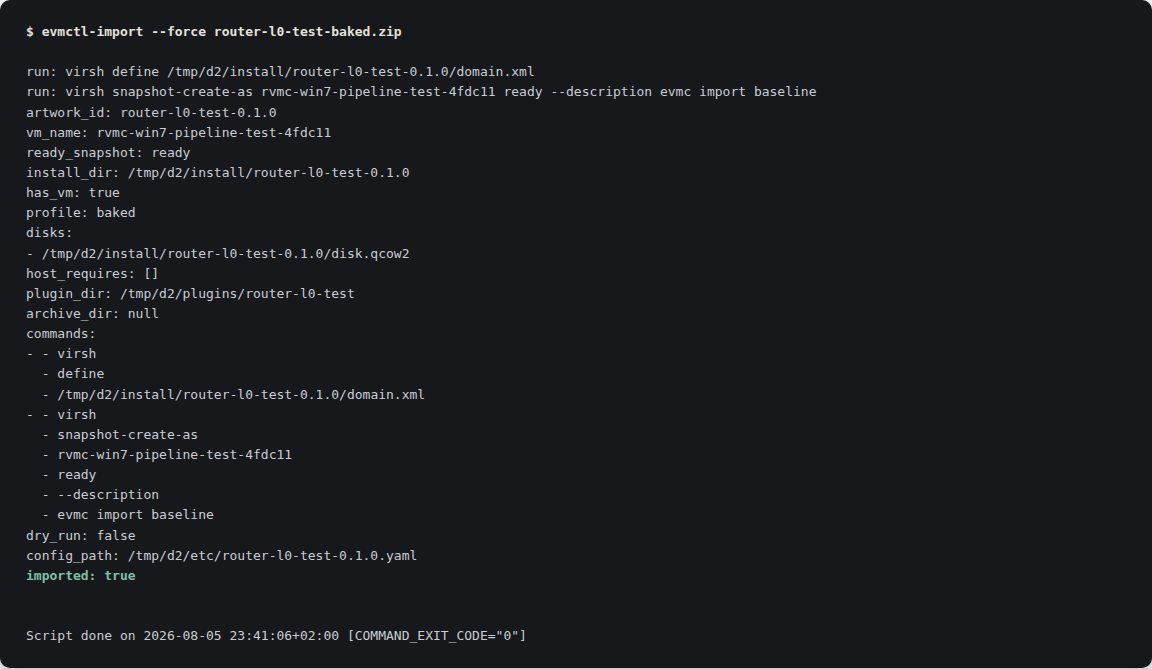
Once a work is brought up and verified, evmctl captures that whole-machine state as a “ready” snapshot. From then on, small scripts inside the guest — the artwork’s virtual machine — send a periodic heartbeat, an “I am alive” signal, to the host controller, the program on the real computer that supervises the virtual machine. When the heartbeat stops, the host does not try to diagnose or repair anything; it simply reverts to the ready snapshot, and within two to five seconds the work is running again from its known-good state. Configuration never drifts, because every recovery returns to the same captured moment.
What can trigger a recovery
- Heartbeat timeout — no signal from the guest for a configurable window (default ~10–15 s).
- VM-shutdown detection — if someone shuts the virtual machine down (even with
the virtualization software’s own
virsh destroycommand), the host notices within a fraction of a second and restarts it into the ready state. - Guest-agent ping — a liveness check built into the virtualization software itself (the QEMU guest agent), independent of the network (optional).
- Application error signals — a guest script can report a crashed process, an idle timeout, or any artwork-specific failure immediately.
This is the system that proves a work can run. The exhibition it was built for is the next chapter.